We are going to cut some ideas out so we can fit the 10 second time frame so if they were kept it it would have gone over time and wouldn't be accepted.
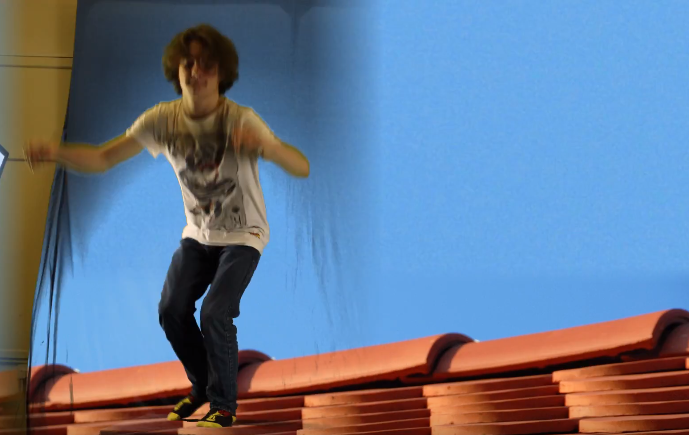
Jumping off of tables will be a health and safety issue so we will be very careful when filming those scenes.
How many people are in your team and what is/will be your role?
there are 2 people in the team, me and Faye. I will act in it and Faye will record the footage necessary.
When is the pre-production, production and post-production deadline?
October 30th - 22nd November
The soundtrack we will use will be a track provided by E4 as specified in the brief to be entered into the competition
BRIEFS What is a brief/project brief?
A project brief is a set of guidelines that you must follow in order to submit the work. for example the BBC states you must create work that fits a following target audience of 16 - 32 year old
What is a commission/what does it mean to be commissioned?
being commissioned is being tasked in order to create a piece of media for either a company or people asking for people to create things for them. for either a budget or exposure from everyone. What is meant by the term ‘tender’
A tender is the process in putting yourself up for hire to create a piece of media in exchange for money. A tender brief is when an company releases their brief to the public and allow anyone to follow it so instead of what commission does and have it so only one person or company can do it, in this case anyone can decide to do it and then send it to the company and allow to view them and pick the best one and use it.
How else could you respond to a brief?
A brief can be responded to if it's a competition or something among those lines in which you respond by sending in a specific piece. READING A BRIEF
For our project we had to create a piece to enter into the E4 Ident competition. the guideline criteria specified that we had to create a piece that was up to 10 seconds in length that included specified music that E4 stated and provided and since we were given the music we selected the Jazz music for the comedic tone. There were many different soundtracks to choose from and they were provided to us by the college files.Finally, the E4 logo had to be in the animation, we were only allowed to use the logo in this video only. I used the logo at the end of my ESting.
NEGOTIATING A BRIEF
In this project we had flexibility of what we could create as long as it was suitable for audience. a stop motion animation, under 10 seconds and used specific music. but anything else the project included could be anything we wanted. we had to do very specific things, for example. In order to reach ten seconds, we had to take 120 pictures. In order to make it stop-motion.
The E4 logo is copyrighted material which is allowed to be used in this competition only and is not allowed to be used on anything else, this also applies for the soundtrack that is designated (This can be seen on rule 8 above)
This is the copyright law that the logo/soundtrack falls upon.
In the media industry some companies may not want their ideas changed much so following a brief to the dot is essential.
In constraints you might face you could not have enough actors or budget. one particular problem that arose from our project was that since it was about a man falling from a building and was shown comical. some concerns were still raised that it may show suicidal themes. we also faced some issues with our budgeting but we managed to work around it by finding other uses for the materials used.
We did make some amendments to the final product. we made it slightly longer so it fit the 10 second brief criteria. we did that by extending the middle of the animation to run a bit longer. as well as make the content more interesting.
An example for a director who left a production was Guillermo del Toro on the Hobbit He left the production because the Co-funders of The Hobbit films, MGM, was going through heavily-reported financial issues at the time, and as such, as del Toro revealed in May 2010, the films had not been officially greenlit at that time. Furthermore, he added that the films wouldn't be until the MGM financial issues were resolved. Two days later, del Toro walked away from the director's chair, nearly two years after he took the job on.
OPPORTUNITIES
People respond to a brief to get work to do as well as experience in the media field. for example if i were to put a piece to a competition and won that competition i would receive a prize and have exposure to the media world.
For self development i discovered that animation is harder than it seems and that shooting them is very time consuming and I would not like to continue it
Becoming famous through competitions:
Le Cheval 2.1 by Stephen Scott-Hayward & Alex Kirkland was the winner of the Depict! competition, from then on Stephen Scott-Hayward went onto Hollywood to produce some much higher quality short films
For example, in the media industry, Actor Samuel L. Jackson and director and writer Quentin Tarantino have worked together for 20 years over 5 different films. Their first film they worked on together was Pulp Fiction, which is what Samuel L. Jackson is perhaps best known for.
I learnt how to animate and learnt how animation is animated in pairs, animating in pairs means that animation is held for 2 frames rather than films where films run at one frame. So animation overall runs at 12 unique frames per second whereas in films it's 24 unique frames.
Q 1 Age,Gender,Occupation: most of my respondents were students around the ages of 17-19 as well as having an even distribution of Male and female, with the ages it got responses from reflects the target audience we were going for.
Q 2 Animation rating: the average number given was a 6.6/10 meaning it was quite average to the audiences. I think a reason for this is that it was short and the green screen at the beginning wasn't done well.
Q 3 Genre: the genre feedback for this Esting is that it is of a comedical style This was the intended purpose for the animation due to his comedical actions whilst falling so the audience was correct in genre
Q 4 Was the narrative clear?: The answers of this question were very equal of people understanding the narrative and not understanding. to me the narrative isn't too clear and that understandable like why would he be jumping? why would he be doing stupid stuff? is this man okay?
Q 5 Age: for this question the majority answers were that it was aimed at 10-12 years which isn't what our audience was planned to be it was planned to be for young adults.
Q 6 Style of animation: Everyone responded to the questionnaire saying that this is a stop motion animation which is good because it is and that what the brief asked for.
Q 7 Character choice: the choice for character was well liked by the audience except for 2 responses one reporting we need an authoritative figure. The fact they enjoyed the character was good
Q 8 Animation smoothness: This question was met with responses that were Evenly halved. Personally i believe it didn't run very smooth as there were a lot of frames in which the character jumped forward great distances.
Q 9 Aesthetics: For the aesthetics the color choices were praised a fair bit as well as the ending where the character fell into the logo. On the comments about colors one answer said they liked how the color was consistent throughout the whole animation. I think the color scheme is basic and that gives it quite a comic tone with having bright colors.
Q 10 Creativity: For the creativity of the animation the falling was commented on a lot. I think that creating a entirely impossible action and something that could be viewed as quite dark into something comedical and entertaining as well as being possible to do.
Step 3:
In creating our animation we faced some financial difficulties by having to purchase wallpapers. as can be seen on the finance sheet so we solved this by receiving some funding from the college. as well as some safety issues when we filmed the first section on the roof we worked around this by stabilizing the tables and risk assessing before hand.
We were very efficient with our time, filming was completed in about two hours and editing was very quick. we had to re shoot as well due to the footage not being long enough but even then that was filmed quite quickly in about an hour.
The requirements of the brief were met as well as the requirements of the competitions (As can be seen below) . as we were tasked to create a stop motion animation that has a length of about 10 seconds and we managed to create that and these were all in the guidelines of the competition rules as well as using the competitions specified music if the music isn't used as they specified then it can't be submitted to the competition.
I obtained feedback from friends and family some of them responded positive but they mostly had constructive criticism especially concerning fluidity of animation and change of the characters clothing.
I feel from this animation task that it's much harder than it seems and sometimes ideas just don't work when you put them into action yet some do such as my animation Because it originally had a much shorter middle section however we created more ideas and made it longer but some ideas were cut from the final version. for example we were gonna have a second person but didn't due to time constraints.
I think i could quite easily work to all briefs given as long as they are written well because as i have just shown in this unit i am fully capable of doing so
I do not like shooting animation so continuing it in the future isn't really something i would want to do as i think it's quite boring and takes way too long to film for the things you create however claymation does slightly interest me
For the selection of format i have decided to create a E-sting using stop frame animation with humans. This is because would be very fitting with last Estings and it could have very comedic value if it is done correctly.
The E-sting will be a person falling from a building but as he falls things will happen (drinking tea. Playing a instrument etc.) and when he lands, he lands on the E4 logo. using a realistic looking wallpaper it gives a home made feel to the animation whilst giving the illusion that the character is falling.
The animation will be set on top of a building and as he falls the building will always be seen on the side of the screen.
The issues we may face is getting some brick wallpaper to go on the edge for the building will be a cost we must pay. a green screen was a suggestion but I do not think it would be as aesthetically pleasing as the wallpaper.
Audience: Young adults, both genders, comedic. C2DE classed. Their interests would be probably in using social media, spending time with friends, watching films/TV. A genre of film that they would possibly like would be comedy, hence why our ESting is a comedy so it appeals to the audience.
We require the usage of designated Esting soundtracks because that's what the brief requires and if they aren't used then we aren't allowed to enter the competitions. we have selected one of the jazz pieces because it was the most comedic of all of the music pieces.
Part 1:
E4 is owned Channel Four Television Corporation. "it was launched in 18th January 2001" so it's been around a solid 16 years. The channels most popular shows are The inbetweeners and big bang theories among many others.
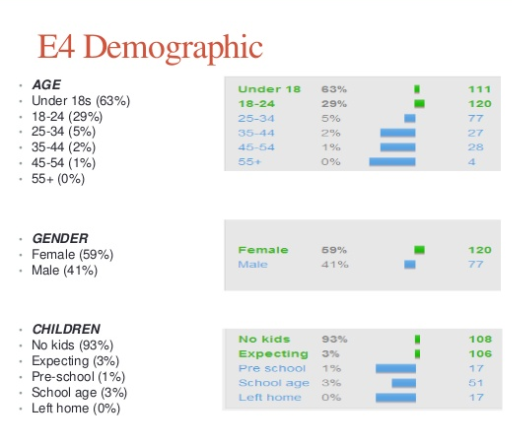
The E4 demographic is aimed primarily between 16- 34 year olds particularly female. due to their ruder humor comedies and intense dramas. it also appeals to a much more mainstream audience of a lower class. 16-34 bias, C2DE and ABC1, Female bias, Housewives
Part 2:
An E-sting is a competition for budding animators to create an animation which features the E4 Logo. these are called "Idents" idents stand for Product identity
Genre: Comedy Audience: Younger children because it's like Pinocchio Content: a man fishing gets eaten by the E4 logo and then is seen inside the Logo
Genre: Comedy Audience: Adults because it spookier than the others Content: a child doing hand shadows keeps making hand shadows until it turns ridiculous and it zooms out and then the child has 10 additional fingers
Genre: Comedy Audience: Everyone because of the animals Content: it follows a spooky house filled with animals which have regal clothing drawn over them.
Part 3:
The two animations created above were for the A to B and Inanimate objects task in which we had to create a short stop motion with people and then with inanimate objects. Part 4:
For my E-sting I shall create it with human figure stop motion because looking at them more and more the human ones are more fluid and you can convey more with facial animations as well as movements.
A to B:
For this animation we were tasked to have a human being move from one point to another using a bizarre and impossible method, for my animation we had someone skate on a wet floor sign knocking over someone and them sliding into a door
What went well?
the ending bit where the door was hit with the added sound effects
The spin on the sign
The sliding along the floor
What could be improved?
The fact that Nic disappears as he hits into me
lengthened the beginning and make Nic do more funky tricks on the sign
Inanimate objects: For this animation we were tasked with creating an animation using only inanimate objects. For my animation I decided to create an animation about war between forks, spoons and knives battling over a burger.
What went well?
the animation worked smoothly with multiple objects
The music fitted well with the animation
Background worked well
What could be improved?
The length of the animation
The white border around the edge of the background
Let Go Of Me:For this animation we were tasked of creating Lego characters and then animating their mouths in order to create them saying the phrase "Let go of me". we created a Lego duck and dog and had the dog wanting to get let go however we didn't finish it on time so we can't show an example. so we needed to improve our skills at time keeping.
For my E stig animation I would probably choose to select the inanimate objects animation
Part 1
Persistence of vision:
Animation works by using an optical illusion. By presenting a sequence of still images in quick enough succession, the viewer interprets them as a continuous moving image. This is the same principle that enables live action film making and projection to work. Film theorists often refer to this illusion of movement as the persistence of vision.. Persistence of vision works because the human eye and brain can only process 10 to 12 separate images per second, retaining an image for up to a fifteenth of a second. If a subsequent image replaces it in this period of time it will create the illusion of continuity.
Animation in pairs:
Animation is held for 2 frames rather than films where films run at one frame. So animation overall runs at 12 unique frames per second whereas in films it's 24 unique frames.
Thaumatrope:
A thaumatrope is an optical toy that was popular in the 19th century. The invention of the thaumatrope is usually credited to British physician John Ayrton Paris. Paris was said to have used one to demonstrate persistence of vision to the Royal College of Physicians in London in 1824. A thaumatrope works by having 2 images drawn on either side of a circle and attaching string to the sides, when the string is spun, the two images appear to be the same. the visual example I created is shown below with the video. these animations were sold as toys by vendors.
Phenakistoscope:
In 1832, Belgian physicist Joseph Plateau and his sons introduced the phenakistoscope ("spindle viewer"). It was also invented independently in the same year by Simon von Stampfer of Vienna, Austria, who called his invention a stroboscope. the Phenakistoscope was the first widespread animation device that created a fluent illusion of motion. The device was operated by spinning the cardboard disc, and viewing the reflection of the image in a mirror through a series of moving slits.
Example:
Zoetrope:
The zoetrope consists of a cylinder with slits cut vertically in the sides. On the inner surface of the cylinder is a band with images from a set of sequenced pictures. As the cylinder spins, the user looks through the slits at the pictures across. The scanning of the slits keeps the pictures from simply blurring together, and the user sees a rapid succession of images, producing the illusion of motion.William Ensign Lincoln invented the definitive zoetrope in 1865. my own example can be seen below.
Praxinoscope:
The Praxinoscope is a typical optical toy from the 19th century. It consists of a cylinder and a strip of paper showing twelve frames for animation. As the cylinder rotates, stationary mirrors in the centre reveal a ‘single image’ in motion. The Praxinoscope was invented in 1876 by Charles-Émile Reynaud (1844-1918), a Paris science teacher My example is below.
Kinetoscope:
creating the illusion of movement by conveying a strip of perforated film bearing sequential images over a light source with a high-speed shutter. invented by Thomas A. Edison and William Dickson of the United States in 1891. below is an example of the kinetoscope which is of the creator sneezing.
Info gathered from:
https://www.futurelearn.com/courses/explore-animation/0/steps/12222
https://en.wikipedia.org/wiki/Thaumatrope https://en.wikipedia.org/wiki/Phenakistiscope http://courses.ncssm.edu/gallery/collections/toys/html/exhibit07.htm http://zoetrope.org/zoetrope-history http://www.mhs.ox.ac.uk/exhibits/fancy-names-and-fun-toys/praxinoscope/ Part 2 George pal
Where/When born?: Pal was born in Cegléd, Hungary, in February 1, 1908
George Pal worked with puppets and time lapses. He is behind the films 'The Time Machine' and 'The War of the Worlds'. he began work creating cartoons for children called the puppetoons, these were animated short films featuring a cast of animated puppets
This clip shows the time lapse photography and stop motion used in the Time travel scene.
Willis O'Brien
Where/When born?:March 2, 1886.Oakland, California, U.S.
Though his method of live action mixed with stop motion
animation is a standard process today, the special effects techniques developed
by Willis O'Brien was ground-breaking.
For the first time, a cellulose-acetate screen was used for rear
projection. This new type of cellulose
screen was flexible and stretched over a frame like canvas. He also began using
a blue screen behind live action actors to allow them to be matted into
existing footage. This technique as well as rear and miniature projection improved
the optical process. Until computer
animation became widely used, these techniques were utilized in most monster
films until the 1990's.
Ray Harryhausen
Where/When born?: June 29, 1920. Los Angeles, California, U.S
Ray Harryhausen found his fame in creating prehistoric films and the research of Dynamation. His most famous film was 'Jason and the Argonauts', which featured early stop motion footage of a variety of creatures made from clay, such as skeletons and a moving statue.
Phil Tippet
Where/When born?: in Berkeley, California, USA
, Tippett headed the ILM animation department with Jon Berg for The Empire Strikes Back (released in 1980). For this film, Tippett co-developed the animation technique called go motion to animate the sinister AT-AT Imperial Walkers and the hybrid alien tauntauns. In 1981 Tippett continued using go motion for Dragonslayer
Otmar Gutmann
Where/When born?: April 24, 1937 in Münstertal/Schwarzwald, Germany
was a German television producer, animator, and director. He is best known for his long-running creation of the British-Swiss stop-motion children's television series Pingu. He produced the show during 1986 to 2000 by a Swiss animation studio named Tricksilmstudio
Tim Burton/Henry Selick
Where/When born?:
Tim: August 25, 1958. Burbank, California, U.S. Henry: November 30, 1952. Glen ridge, New jersey, united states.
Tim Burton and Henry Sellick work using very detailed puppets and small models. they are well known for their abstract and usually creepy style of film. Most famously, they created 'The Nightmare before Christmas' which was entirely stop motion.
Adam shaheen
Where/When born?: October 13, 1964 (age 52) London, England
He is the founder and owner of Cuppa Coffee Studios where he develops and produces all original programming. Shaheen's credits include shows and movies like JoJo's Circus, Celebrity Deathmatch, Starveillance, Bruno, Bruno and the Banana Bunch, Tigga and Togga, Little People among other works
The Brothers Quay
Where/When born?: 1947 in Philadelphia, Pennsylvania, USA
The brothers Quay create their film using inorganic items such as dolls or screws, using disassembled and rearranged. The style of their films is unusual and relies heavily on music without much dialogue.
Nick Park
Where/When born?: 6 December 1958. Preston, Lancashire, England
best known as the creator of Wallace and Gromit and Shaun the Sheep. His 2000 film Chicken Run is the highest-grossing stop motion animated film. In 1985, he joined the staff of Aardman Animations in Bristol, where he worked as an animator on commercial products (including the video for Peter Gabriel's "Sledgehammer", where he worked on the dance scene involving oven ready chickens). He also had a part in animating the Pee-wee's Playhouse which featured Paul Reubens.
Info gathered from:
George pal:
https://en.wikipedia.org/wiki/George_Pal
Willis O brien:
https://en.wikipedia.org/wiki/Willis_H._O%27Brien
Ray harryhausen:
https://en.wikipedia.org/wiki/Ray_Harryhausen
Phil Tippet:
https://en.wikipedia.org/wiki/Phil_Tippett#Stop_motion
Otar guttman:
https://en.wikipedia.org/wiki/Otmar_Gutmann
Tim Burton:
https://en.wikipedia.org/wiki/Tim_Burton
Adam Shaheen:
https://en.wikipedia.org/wiki/Adam_Shaheen
Brothers Quay:
https://en.wikipedia.org/wiki/Brothers_Quay
Nick park:
https://en.wikipedia.org/wiki/Nick_Park
(Links used to find dates of birth and works created) Part 3
TV programmes:
Wallace and Gromit appeals to people of all ages. with it's ridiculous plots (for example a penguin with a revolver being chased on a toy train) and it's colourful settings and characters. Postman pat appeals to children primarily due to how colourful it is, it's upbeat theme and simplistic character designs.
Feature Film:
Kubo and the two strings focuses at a more teenage audience with themes such as monsters and a more darker color scheme presented throughout, a more complicated narrative and much more action and adventure than other animated films. Advertisement:
The xbox commercial is targeted towards everyone because of the highly memorable characters that get created. The Honda advert is targeted at an older audience with it's antique feel of animating with paper and it showing time passing.
Music video:
These are targeted towards more older audiences due to the animation being very artistic, which the vivid colours and creativity and different to the sort of childish animation of Clay modelling. Part 4
Stop motion is a very powerful story telling medium that I believe began as a more adult aimed audience as most of the older animations had a much deeper meaning and were slightly creepier but as time went on it became a more child friendly medium with things such an pingu and postman pat.
I believe that stop motion won't ever be outdone by computer animation because there are certain feels that can't be captured in computer animation for example the gothic feel of tim burtons films
just wouldn't be captured well in computer animation. this links to the documentary Pencil to pixel